Storms & tornadoes
A steel-reinforced concrete core, the same kind of wall FEMA safe rooms are built from. No studs to snap, no sheathing to peel off.
Sustainable building materials · Middle Tennessee
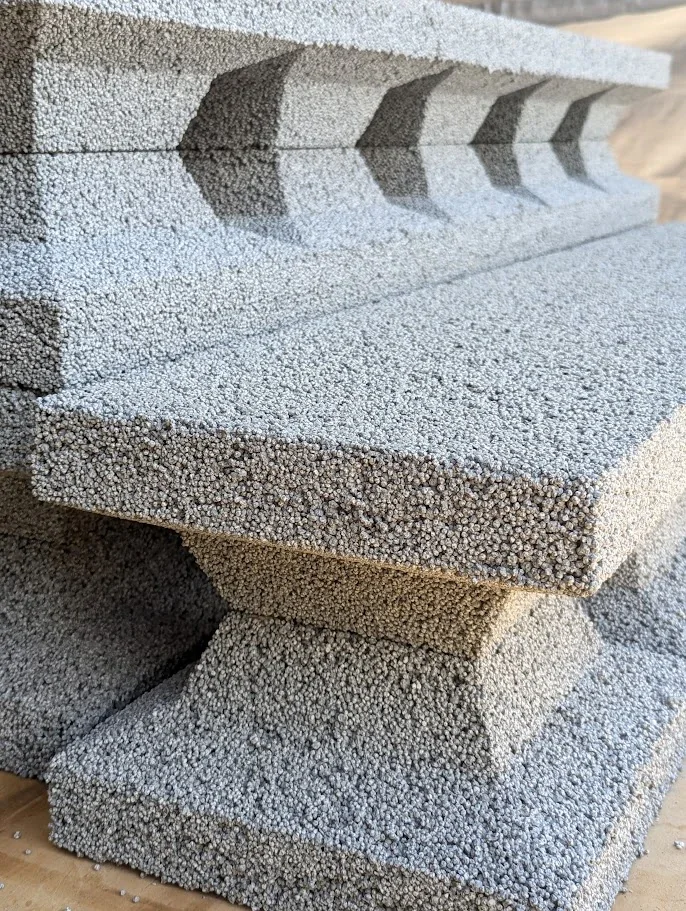
We are getting ready to turn the packaging foam Nashville throws away into insulated concrete building blocks: walls that are fire-resistant, energy-efficient and built to last, made from material headed for the landfill.
The problem
Expanded polystyrene (EPS) is the white foam packed around appliances, electronics and furniture. It is mostly air, light and bulky, and less than 4% of polystyrene packaging in the US is recycled. Retail stores, appliance deliveries and job sites in Nashville generate it by the truckload, and most of it goes to the landfill, where it does not break down.
Meanwhile the region is building faster than ever, mostly in wood frame: walls that burn, rot, feed termites and leak heat. We think those two problems cancel out.
Foam by the numbers
Polystyrene foam is light, bulky and cheap to make, which is exactly why so little of it gets recycled: shipping it is mostly shipping air. Here is the scale of the problem Common Block is built to take on.
550,000tons
of polystyrene containers and packaging generated in the US in 2018
Source: EPA
3.6%
of that polystyrene packaging was recycled. The rest was landfilled or burned.
Source: EPA
146million tons
of US municipal waste went to landfill in 2018: half of everything thrown away
Source: EPA
~95% air
by volume: why foam is costly to haul and fills landfill space out of all proportion to its weight
Source: EPS industry (95–98%)
Metro Nashville Waste Services opened Tennessee's first city drop-off that takes both foam packaging and food-service foam, at the East Convenience Center, with a densifier donated by the Polystyrene Recycling Alliance. The collection is in place. Common Block wants to be the local maker that turns it into walls.
Built to repeat
Foam waste isn't a Nashville problem. It turns up wherever appliances, electronics and furniture are delivered, which is everywhere. That's what makes the model portable: a small plant, local foam, local crews, local walls. Once it works here, the same playbook can be repeated in cities across the US and in other countries.
Collect locally
Partner with the city, retailers and job sites already producing foam.
Cast locally
A compact plant near the foam, so it never travels far as bulky waste.
Build locally
Sell to builders in the same region, keeping jobs and value in the community.
Repeat
Take the proven mix, line and playbook to the next city.
Why Common Block
Tornadoes, the 2010 flood, summers in the 90s and winters that freeze the pipes: Nashville asks a lot of its houses. A reinforced concrete wall answers all of it, and ours is made from the city's own waste.
A steel-reinforced concrete core, the same kind of wall FEMA safe rooms are built from. No studs to snap, no sheathing to peel off.
Cement-bonded blocks will not burn, and the insulated shell keeps summer heat out and winter heat in.
Nothing in the wall rots or feeds mold. After high water, concrete dries out and stays standing.
Walls built to stand through the worst Tennessee weather.
Lower heating and cooling bills for as long as the house stands.
Every wall locks away foam that would otherwise sit in the ground for centuries.
The plan: local foam, local manufacturing, local jobs. Nashville money stays in Nashville.
Where we are
Common Block is at the starting line. The hard parts we can do ourselves are done: we know how to make this block and how to run the line that makes it. What we can't do alone is put it all in place in Nashville. That's where local support comes in.
Five feet long, hexagonal cores, how it is made and how it performs.
How insulated composite concrete forms work, how they compare and how they are tested.
Why Nashville’s foam waste and housing needs belong in the same sentence.
From notebook sketches to blocks in real homes.
Get involved
We're not manufacturing yet. We have the plan, the block design and the know-how to run the line; what we need now is local support to get it started: a space, foam supply, funding and partners.
We're also lining up 3–5 Nashville-area builders to pilot the first walls once production starts, at demonstration pricing with direct support from our team.
Or email hello@castelle.studio